Introduction
A state wide area network is a government communication infrastructure that connects different government departments across an entire state.
It allows data, voice, and video communication between state headquarters, district offices, and local government bodies.
The main purpose of a state wide area network is to improve coordination, communication, and digital services across government institutions.
These networks are commonly used in e-governance projects to ensure that public services reach citizens efficiently.
In India, many states have implemented State Wide Area Network (SWAN) systems to strengthen digital governance and administrative connectivity.
What Is a State Wide Area Network?
A state wide area network is a type of computer network that connects government offices across a state using high-speed communication infrastructure. It acts as a backbone network for government services and digital applications.
Unlike local networks that work within a small area, a state wide area network covers a large geographical region such as an entire state.
Key characteristics include:
- Connecting multiple government offices
- Supporting secure data communication
- Providing reliable network access for e-governance
- Enabling digital public services
This network allows state governments to deliver services such as online certificates, digital records, and administrative communication.
State Wide Area Network Established for E-Governance
The state wide area network established in many regions is part of a larger national e-governance plan.
Governments recognized the need for a strong communication infrastructure to manage digital services efficiently.
When a state wide area network established within a state, it connects several administrative levels:
- State Headquarters (SHQ) – The main control center of the network.
- District Headquarters (DHQ) – Connects district government offices.
- Block Headquarters (BHQ) – Connects local administrative units.
This structure ensures that information flows smoothly from the state government to local offices.
Understanding State Wide Area Network (SWAN)
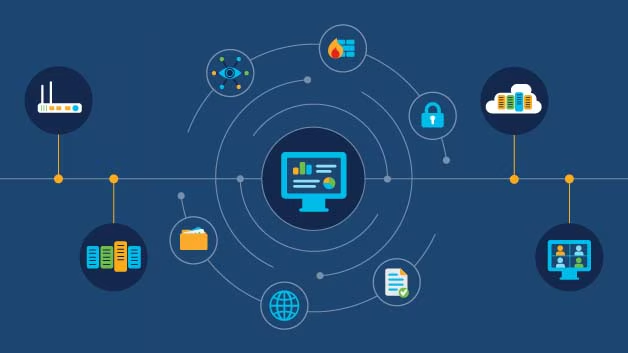
The State Wide Area Network (SWAN) is a major government initiative designed to create a secure digital communication network for state administration.
SWAN infrastructure typically includes:
- High-speed fiber optic connectivity
- Network routers and switches
- Data centers and servers
- Security systems for data protection
The goal of State Wide Area Network (SWAN) is to support government departments in delivering services efficiently and digitally.
SWAN networks help integrate various government systems such as:
- Land record management
- Public service portals
- Administrative communication platforms
Structure of a State Wide Area Network
A state wide area network is usually built using a three-tier architecture.
1. State Headquarters Level
The top level of the network is the state headquarters. It manages the entire communication system and controls network operations.
2. District Level
District offices connect to the state headquarters through high-speed communication links. This allows data sharing between different government departments.
3. Block Level
The block level connects local government offices and enables public service delivery to citizens in smaller administrative regions.
This three-layer structure ensures that government services reach every part of the state.
State Wide Area Network in Hindi
Many students and learners search for state wide area network in Hindi to understand the concept in their native language.
In Hindi, state wide area network can be explained as:
State Wide Area Network MP
The State Wide Area Network MP refers to the network infrastructure developed in the state of Madhya Pradesh, India.
The State Wide Area Network MP was created to connect government departments and improve digital service delivery across the state.
Key objectives of this network include:
- Improving communication between government offices
- Supporting e-governance services
- Providing reliable connectivity to district and block offices
- Enabling faster access to digital records and applications
By implementing the State Wide Area Network MP, the government improved coordination among administrative departments.
Benefits of a State Wide Area Network
A state wide area network provides many advantages for government administration and public service delivery.
Improved Communication
Government departments can communicate more efficiently through secure digital channels.
Faster Data Sharing
Information can be transferred quickly between state, district, and local offices.
Support for E-Governance
Digital services such as online applications and government portals rely on strong network connectivity.
Increased Transparency
A state wide area network helps create transparent systems where data is easily accessible and traceable.
Better Service Delivery
Citizens can receive government services faster when administrative systems are connected digitally.
Applications of State Wide Area Network
A state wide area network supports many government operations and digital services.
Common applications include:
- Online government portals
- Digital land records management
- Video conferencing between government offices
- E-district services
- Online document verification systems
These applications help modernize government operations and improve efficiency.
Challenges in Implementing State Wide Area Network
Although state wide area network systems offer many benefits, there are also some challenges.
Infrastructure Costs
Building a large communication network across an entire state requires significant investment.
Maintenance and Security
Government networks must be protected from cyber threats and technical failures.
Connectivity in Rural Areas
Providing reliable internet connectivity in remote areas can sometimes be difficult.
Despite these challenges, many states continue to invest in SWAN infrastructure to support digital governance.
Future of State Wide Area Network
The future of the state wide area network looks promising as governments focus more on digital transformation.
Future improvements may include:
- Faster fiber-optic networks
- Integration with cloud technology
- Stronger cybersecurity systems
- Expanded connectivity to rural regions
These developments will help governments deliver services more efficiently and improve citizen access to digital platforms.
Conclusion:
A state wide area network plays an important role in modern government administration. It connects government offices across a state and supports efficient communication, data sharing, and digital service delivery.
Initiatives like State Wide Area Network (SWAN) and projects such as State Wide Area Network MP have helped strengthen e-governance infrastructure in many regions.
Understanding concepts like state wide area network established, state wide area network in Hindi, and the structure of SWAN helps students, professionals, and citizens learn how digital governance systems operate.
As technology continues to evolve, the state wide area network will remain a key component of digital government infrastructure and public service delivery.